Community Life Engagement
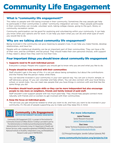
ICI developed the four guideposts for community life engagement (CLE) and the CLE toolkit to provide a framework and examples of what high-quality day services and supports should look like. The most recent addition to the toolkit is the CLE Fidelity Scale (CLEFS), a statistically valid and reliable tool for service providers to assess how their current day services and supports align with the four guideposts.
This brief applies the Four Guideposts for Community Life Engagement to identifying virtual opportunities for interaction and engagement and supporting people with IDD to access such opportunities.
As states focus on expanding integrated employment opportunities for people with intellectual and developmental disabilities (IDD) and phase out sheltered work, they are finding a need to concurrently examine day services and supports that promote Community Life Engagement (CLE, see yellow box to the right for a detailed definition). These supports can be a wrap-around to ensure individuals’ engagement in the community is maintained and they continue to receive sufficient levels of support, despite fluctuations in job status and hours.
The State Employment Leadership Network (SELN) is a membership-based network of state IDD agencies committed to making changes in their service systems to ensure access to competitive integrated employment for people with IDD (www.selnhub.org/home).
We have created a series of four Engage Briefs to examine the guideposts in detail. This brief explores the need to implement a plan to help individuals participate in and contribute to their communities.

Click here to read the full brief
We have created a series of four Engage Briefs to examine the guideposts in detail. This brief explores the need to tailor supports to an individual's needs and goals.
Click here to read the full brief
SEEC (Seeking Equality, Empowerment, and Community) is a Maryland-based provider of employment, community living, and community development supports to people with intellectual and developmental disabilities (IDD). Like many providers of individualized supports, SEEC has had to find creative ways to individualize supports even though its funding structures do not support 1:1 staffing. One way they do this is by deliberately building both human capital (community living skills) and social capital (relationships in the community).
LOQW (Learning Opportunities/Quality Works) is a community skills training, service coordination, and employment services provider in northeast Missouri. LOQW operates several satellite offices in addition to its main office in Monroe City, MO. One of these satellite offices is located in Hannibal, MO, a city with a population of less than 18,000. But being located in a small city does have its advantages. One advantage is that a majority of the Hannibal staff has lived there for their entire lives, and they have countless connections in the area.
The purpose of this brief is to:
1. Present findings from 13 expert interviews regarding essential elements of high-quality Community Life Engagement, organized into four guideposts.
2. Consider these guideposts as a set of key principles states and providers can use to move their Community Life Engagement efforts forward.