This report describes the employment and economic outcomes for individuals with and without intellectual disabilities in 2017. Results are summarized for the 50 states and the District of Columbia. These data are divided according to race, ethnicity, and gender and are drawn from the American Community Survey, the Rehabilitation Services Administration 911, and the National Core Indicators.
Christina is an energetic young woman who works at Bothwell Hospital in Sedalia, Missouri as a part-time dietary aide. She enjoys her job and earns well above minimum wage. During the COVID-19 pandemic, Christina’s work conditions and responsibilities changed. As a result, the nature of her supports also shifted from having an on-site
job coach
to remote supports via iPhone. With the support of her provider, the Center for Human Services (CHS), Christina was able to alter her position and supports and maintain employment.
This document contains the slides from a presentation given at the APSE national conference in 2019. It presents statistics that illustrate the characteristics of relatively higher-performing state systems with regard to employment and community engagement outcomes for individuals with IDD. Click here to view the presentation slides.
In FY2016, an estimated 638,568 individuals received day or employment supports from state IDD program agencies. This number grew from 455,824 in FY1999. The estimated number of individuals in integrated employment services increased from 108,227 in FY1999 to 120,244 in FY2016. Despite the trend to terminate facility-based services in some states, the overall state investment continues to emphasize non-work services, rather than integrated employment services.
This brief is the third in a series focusing on Employment First implementation as it relates to one of the seven elements within the High-Performing States in Integrated Employment model. As states undergo implementation of their policies, it is important to understand how state agencies have built employment knowledge and capacity. Download here.
This brief is the second in a series focusing on Employment First implementation as it relates to one of the seven elements within the High-Performing States in Integrated Employment model. It looks at the
interagency collaboration
and partnership element in depth. Interagency partnership and collaboration includes interagency agreements and relationships, provider collaboration, and outreach to stakeholders to ensure that integrated employment is a shared goal.
Izzy is 23 years old and lives with her family in Tampa, Florida. She loves swimming, working out, and baking. An internship at an assisted-living facility and related classes at the University of South Florida's Learning Academy helped her succeed later at her first paid job.
This brief is the first in a series focusing on Employment First implementation as it relates to one of the seven elements within the High-Performing States in Integrated Employment model. It examines the background of circumstances under which Employment First efforts began in seven states, and introduces each state’s values, mission, and goals around increasing employment opportunities for people with disabilities.
Jeremy lives in Griffith, Indiana, and says he is always busy and trying to better himself. Since graduating from high school, he has held a 35- to 40-hour-a-week job at Cracker Barrel Old Country Store, is completing his final semester towards a college degree in office administration, and is pursuing his passion to be a magician.
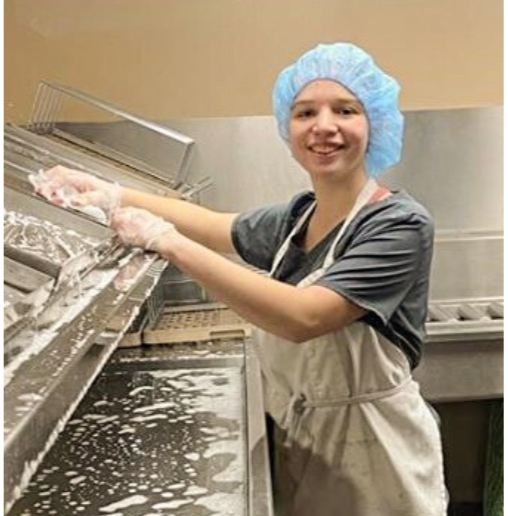 Christina is an energetic young woman who works at Bothwell Hospital in Sedalia, Missouri as a part-time dietary aide. She enjoys her job and earns well above minimum wage. During the COVID-19 pandemic, Christina’s work conditions and responsibilities changed. As a result, the nature of her supports also shifted from having an on-site
job coach
to remote supports via iPhone. With the support of her provider, the Center for Human Services (CHS), Christina was able to alter her position and supports and maintain employment.
Christina is an energetic young woman who works at Bothwell Hospital in Sedalia, Missouri as a part-time dietary aide. She enjoys her job and earns well above minimum wage. During the COVID-19 pandemic, Christina’s work conditions and responsibilities changed. As a result, the nature of her supports also shifted from having an on-site
job coach
to remote supports via iPhone. With the support of her provider, the Center for Human Services (CHS), Christina was able to alter her position and supports and maintain employment. Izzy is 23 years old and lives with her family in Tampa, Florida. She loves swimming, working out, and baking. An internship at an assisted-living facility and related classes at the University of South Florida's Learning Academy helped her succeed later at her first paid job.
 Jeremy lives in Griffith, Indiana, and says he is always busy and trying to better himself. Since graduating from high school, he has held a 35- to 40-hour-a-week job at Cracker Barrel Old Country Store, is completing his final semester towards a college degree in office administration, and is pursuing his passion to be a magician.